Sunday, 20 March 2011

Tuesday 15th March 2011:

I began to create a questionnaire about bullying to give out to students. I looked at a few other existing similar questionnaires to see what sort of questions have been asked and used these if I found them relevant. Hopefully I can give these out next week and evaluate the results.

I then completed the page which I started yesterday looking at the artist, Clay Sinclair. I think it has turned out well. I especially like the gold as it helps it to stand out. I had intended to outline the letters in black but then the ink ran out and I had a gold pen so used this for the meantime. I thought this worked well and used more of it (ie: behind ‘don’t bully me’). I want to include typography in my final pieces, but maybe have more interesting letterforms than the ones I have used here.

I then found a few stories on the Internet from victims of bullying and picked out the key words/ points in their stories (eg: sad, lonely, picked on, easy target). I used red to highlight these words/ points on black/ white. I feel that these three colours represent bullying well as black and white are quite simple, blend in and sometimes hard to see, but there are always things which stand out (ie: the colour red).

I then used this when looking at the artist Claire Brewster further. In her work, she uses things such as maps and then cuts out, for example, birds. I used these typed up stories and key words and cut them into the shape of someone holding their hands to their face. At first it looks like a scared victim hiding their face behind their hands, but then you can see that the hand on the left is in the ‘stop’ position, which could be saying ‘stop bullying’. I could take this further and make this particular hand and position stand out more in order to convey the message in a stronger way. I think it would be useful to do a few more pages similar to this as I think they would be quite effective and could even work well as part of the final pieces.

Target for today: Begin to produce questionnaire (to give out to students). Complete sketchbook page (looking at Clay Sinclair), and continue with sketchbook work relating to bullying situations and emotions (looking at Claire Brewster).

Target for tomorrow: Begin reading Chapter 11 in ‘Bullying’ book – ‘Helping Victims’.

Monday, 14 March 2011


Monday 14th March 2011:

Today, I went back to my research to see what I could use within my development work. I had another look at the image I had found where the sentence ‘the deepest scars are those we cannot see’ had been written on a girl’s face in what looks like black marker pen/ make up. I then decided to find some images where I could write words onto the faces in this sort of style. I wrote words such as ‘trapped,’ ‘abandoned’, ‘ deserted’, ‘revenge’, ‘angry’, ‘lonely’ and

‘depressed’. I think this works well but isn’t as effective as it could be. I could take this further and write on actual faces and take photos, and maybe use makeup instead of pen to make it stand out more. I also feel that the previous page where I had cut the words out of the people has more of an impact visually and gives out a stronger message.

I then went on to look further at the artist Joseph Loughborough and used his work as inspiration when creating another page in my book relating to emotion. I worked over an image and feel that this piece is quite emotive and I like the minimal use of colour. I like how the person could either be the bully or the victim. The bully may feel like this inside (and therefore goes on to bully others), or the victim may feel like this after being bullied. I may try this same effect using different colour palettes and draw my own images to make it more personal.

I also looked at the work of Clay Sinclair again and used the piece ‘judge me (by my…)’ when carrying my idea of saying ‘don’t bully me because of my…’ instead of ‘judge me by my…’. I then wrote words such as ‘looks’, ‘ethnicity’ and ‘intelligence’, using different type styles. I still need to work into this piece further and complete it so that it stands out as an overall image.


During my research today, I came across an anti-bullying campaign (The Bully Suicide Project: Giving Victims of Bullying their Voices Back) presented by Campus Harmony. Words had been written on the victims faces (which also relates to my sketchbook work), and they’re holding a large card in front of them saying things such as ‘I’ll stand up for you’ and ‘my scars echo your hate’, which are quite strong messages. There were also a few with facts on and I think that this is an interesting way to present facts in a way that would make people read them. I will consider these visual ideas and will look into this campaign further to see how it could influence my own work. I also discovered that Barack Obama has recently started an anti-bullying campaign, and on the 10th March, they held an event in Washington where they welcomed students, parents, and teachers to talk about how best to combat bullying. This recent issue shows how ongoing and common bullying is, and motivated me further to help. Continuing to research this should help with my project and can help to influence my work.

Target for today: Research artists further and complete more sketchbook pages relating to feelings (that the victim feels), and work influenced by artists’ work.

Target for tomorrow: Begin to produce questionnaire (to give out to students). Complete sketchbook page (looking at Clay Sinclair), and continue with sketchbook work relating to bullying situations and emotions (looking at Claire Brewster).

Sunday 13th March 2011:

Today, I prepared some more sketchbook pages. I also researched some of the artists from the affordable art fair further.

For example Claire Brewster, who uses things such as maps which she then cuts into to create shapes (eg: birds). I think that this is quite an effective and unique way of working and perhaps I could explore this further in my own work. I could perhaps type up a bullying victim’s story and then cut out the shape of the person from this writing. I could do a similar thing with the bully, but maybe have the type bigger to represent that the bully is overpowering. Another idea could be to cut into my work to add shapes rather than drawing on top of the work.

Another artist is Nathan Ford who paints portraits using oil paint. Although, I don’t want my final piece to be a painting, his work is quite effective and the emotions of the people are portrayed well. In my development work I will look at this artist to see how I can show the victim and bully’s feelings using a minimal use of colour and simple shapes.

Target for today: Prepare more sketchbook pages and continue researching artists from the Affordable Art Fair.

Target for tomorrow: Research artists further and complete more sketchbook pages relating to feelings (that the victim feels), and work influenced by artists’ work.

Saturday, 12 March 2011

Saturday 12th March 2011:

I looked up a few of the artist’s names which I wrote down from the Affordable Art Fair. The ones who stood out the most to me in relation to my own work, were: Clay Sinclair, Ros Rixon and Joseph Loughborough.

Clay Sinclair’s work is usually done using acrylic on Perspex. The colours are really bright, and the work reminded me of my own because of the use of type as the main feature within the pieces. The few which stand out to me are ‘Judge Me’, ‘Winners and Losers’ and ‘Massage My Ego’.

The piece, ‘Judge Me’ says ‘judge me by my…’ and then goes on to have many words within the piece, such as ‘religion’, ‘status’, ‘happiness’, ‘talent’ and ‘success’. I could use this within my own work and maybe have something such as ‘don’t bully me because of my… looks, ethnicity, weight, height, voice, intelligence’ etc. I feel that this could produce a fairly strong impact, but maybe the message given wouldn’t be long lasting, and the way in which I presented this would really affect how it would be received.


In the piece ‘Winners and Losers’ I like how each letter, etc, is presented differently. This shows the many different ways in which to use type within work and how each one gives a different effect. If I were to do something similar to this within my own pieces, I think that it would be better to only select a few individual styles to repeat and to produce them with different materials to make them stand out more. However, I do think that this would be quite effective. I also like how you have to look quite hard to see certain words in the piece (eg: the word ‘pain’ on the right-hand side).

I like the use of colour in the piece ‘Massage My Ego’ as it’s simple but stands out. The different sizes of writing help to show that some of the words are more important than others and maybe this would be a good way of showing the different levels of importance (perhaps between the bully and the victim) within my own work.

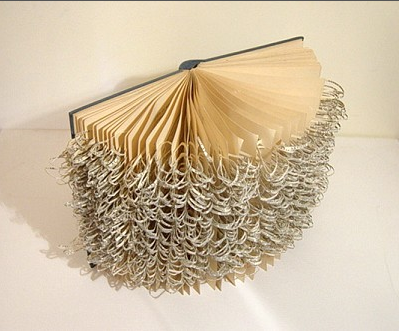
I was really attracted to Ros Rixon’s work at the fair. She uses text and paper to create 3D pieces. One piece ‘Every New Thought’ has many different rings of paper all linked together, which really stands out. I like the idea of maybe doing something similar to this, but using either people’s bullying stories, or words relating to bullying (such as the names which the victim may be called, of the feelings they may feel, or even how the bully may feel in order for them to bully others). I could then take photos of these pieces and use them within my work.

Joseph Loughborough’s work is really eye-catching and really captures emotion. For example, in the piece ‘The Enemy’, the person seems trapped and confused, just by the use of marks made. The different tones of grey help to make it interesting but not too bold and I think that this piece without the use of colour works well. When developing my ideas, I will consider the emotive effect of these pieces and maybe work in a similar way to show the emotions of the characters within my work.


Target for today: A Look up artists written down from the Affordable Art Fair and consider how their work may influences and inspire my own.

Target for tomorrow: Prepare more sketchbook pages and continue researching artists from the Affordable Art Fair.

Friday 11th March 2011:

Today I attended the Affordable Art Fair in London. I saw many contempory pieces, which I really liked, and when viewing them I thought about how these could inspire my own work. I also took part in workshops about drypoint printing (artists working in drypoint draw the image directly onto the plate using a steel tipped ‘pencil’ that produces an added richness due to the burr (or shaving of metal that is turned up at the furrow). As the burrs are delicate and crush easily under the weight of the press, usually less than 50 impressions can be made) and collograph printing (derived from the word ‘collage’. Collographs are created by building up an image on a plate surface (cardboard, metal, or plastic) with glue and other materials thereby creating areas were the ink is retained).

For the drypoint printing, I created an image of an eye crying as I felt this would relate well to my work. I really liked the end result as you could see each of the marks making up the image, which I thought was effective. For the collograph printing, I just used many different textures to see what effect they would produce when printed. I found that the bubble wrap stood out the most and was quite eye-catching. We also printed these on backgrounds with had ripped up envelopes on which helped to make them more interesting. I also had a go at mono printing where I created the image of the eye crying again, which was also quite effective, especially with the contrast between the orange ink and the blue paper.

Target for today: Attend ‘Affordable Art Fair’ and remember what effect I’d like my work to have and how the pieces I see can influence and develop these ideas whilst viewing the work.

Target for tomorrow: Look up artists written down from the Affordable Art Fair and consider how their work may influences and inspire my own.

Thursday 10th March 2011:

I researched some more about Childline and the NSPCC today. A few days ago I discovered that Childline is part of the NSPCC, which I didn’t know before, and therefore felt it important to also research this company.

Put simply, Childline is: ‘a counselling service for children and young people.’ On their website it says: ‘You can contact ChildLine about anything - no problem is too big or too small. 

If you are feeling scared or out of control or just want to talk to someone you can contact ChildLine. 

Some of the things that you might want to contact us about are feeling lonely or unloved, worries about the future, problems about school, bullying, drugs, pregnancy, HIV and AIDS, physical and sexual abuse, running away and concerns about parents, brothers, sisters and friends, and crimes against you.’

It also didn’t occur to me that Childline deals with other things apart from bullying. Although this is beneficial to its users, I feel that having a company just dedicated to bullying would also be a good thing. Therefore, I think that the company which I create will mainly focus on those being bullied as well as the bullies themselves.

When I went to the bullying section of the Childline, this is what it said: ‘Bullying can happen to anyone at any age. Being bullied at school, home or online might involve someone pushing you, hitting you, teasing you, talking about you or calling you names. No one has the right to hurt you or make you feel bad, and if you are being bullied you don't have to put up with it, you can talk to someone about it. If you are being bullied or worried about a friend who is being bullied, there are different ways that ChildLine can help’ and ‘Bullying can also be part of other forms of abuse, including neglect, emotional, physical and sexual abuse.‘. I think that these definitions of bullying are true, and the expectation that it’s not suitable also helps the victim to understand that it’s not their fault and that they have the right to seek help. I think that this is important because usually the victim doesn’t speak up because (apart from being scared), they feel it’s not necessary or they may not even realise that they are being bullied.

I also saw this piece of typography on the Childline website, which I liked as it contained words relating to abuse and feelings/ emotions, as well as looking attractive, which is what I want to focus on within my own work.

When looking at the NSPCC (The National Society for the Prevention of Cruelty to Children) website, it said: ‘The NSPCC is inspired by a belief that we can make a difference for all children. That’s why we aim to end cruelty to children in the UK. Even if it takes many generations to realise it, we achieve much more for children by having this inspirational vision.’ I think it’s important that they’ve noted the fact that it may take many generations to realise that cruelty to children must be stopped but that if they never try to stop it, it may never stop. The NSPCC focuses on a few important issues and groups, which include: those who experience neglect, physical abuse in high-risk families (those families with violent adults, alcohol and drug abuse and mental health issues), those who experience sexual abuse and children under the age of one. I feel that the word ‘cruelty’, which is what the NSPCC focuses on, will always relate to bullying, and so the NSPCC may be more relevant and specific to my work rather than Childline (although this will also be useful to look at). They have stated that to help end cruelty to children in the UK, they: ‘create and deliver the services that are most effective at protecting children, provide advice and support for adults and professionals worried about a child and work with organisations to ensure they effectively protect children – and challenge those who do not campaign for changes to legislation, policy and practice in order to keep children safe.’ It’s interesting that they also focus on challenging organisations that don’t prevent cruelty to children, etc. I will look at these things when thinking about my own organisation, however, I think I would like my organisation to focus on all age groups, and also help those who are taking part in the cruelty, as these are the people who need to be prevented, and therefore helped to do this. Also, I feel that the word ‘organisation’ relates better to the work I am developing rather than the word ‘company’, and so I will be using this word from now on when describing my work.

I also read the rest of Chapter 9 in the ‘Bullying’ book. I read about ‘what can be done about the bully’, where it said ‘there are some principles of aggression management that need to be identified before starting how to deal with the bully: bully in any form is unacceptable, early intervention is important, individuals must take responsibility for their own actions, parents must take responsibility for their own children, failure to deal with the bully will only encourage further aggression.’ I also read about the prevention of bullying, and how this initially needs to be taught by parents when the child is young (eg: being kind to others, etc). It was interesting to read that: ‘it is worth remembering that the word ‘discipline’ comes from the Latin disciplina meaning to teach. The importance of teaching the management of aggressive impulses has already been stressed and clear, consistent discipline is a necessary precondition if children are to have a chance of learning right from wrong.’ This shows the importance of consistent teaching and that it’s not always up to the child to know how to react in certain situations (both as the bully and the victim). Perhaps a part of my organisation can be helping to teach the valuable lessons which will prevent bullying from occurring, as this seems to be one of the main reasons as to why it happens – because some people just haven’t been taught that it’s wrong. It then goes on talk about the differences between preventing the different types of bully (aggressive, anxious and passive). This reinforced my previous thoughts about each bully needing to be dealt with individually and in different ways in order for the attempt to prevent the bully to reach its full potential. I will remember these points when thinking of how my campaign and organisation can help the bully as well as the victim.

Target for today: Continue with research about what companies such as Childline do and read more from ‘bullying’ book.

Target for tomorrow: Attend ‘Affordable Art Fair’ and remember what effect I’d like my work to have and how the pieces I see can influence and develop these ideas whilst viewing the work.

Wednesday, 9 March 2011

Wednesday 9th March 2011:

Today I continued with prepping my sketchbook pages. I also completed another page in my sketchbook with words related to bullying.

I used masking tape to mark out the letters and then used marker pen to smudge around the words. Once the masking tape was removed, the words were revealed and the effect created was quite eye-catching. As in a previous page in my sketchbook, the colours make the smudges look a bit like bruises, and I feel that this relates well to bullying. This is because the words shown here (stupid, fat, weird and sad) can hurt and the emotions you feel from these words can also be painful. This visual message shows the importance of preventing bullying and therefore the effects of bullying. I will consider using these materials, processes and colours again in further work to convey this same message and to create similar effects.

I also like how all the words are connected. This can perhaps represent the fact that although these words may come from different places (ie: different people), they all work together to create how someone feels. This ‘representation’ is quite important and may be something which I would like to explore further. I also want to research the psychological aspects behind bullying, and this exercise of looking beyond the obvious relates well to this.

Target for today: Prep more sketchbook pages and continue with development work in sketchbook focusing on words related to bullying using new materials.

Target for tomorrow: Continue with research about what companies such as Childline do and read more from ‘bullying’ book.